Monday, 24 February 2014

On the steps of kings and queens: Versailles uncovered

I don't know anybody who hasn't heard of Louis XIV, the Sun King, or of Marie Antoinette, the last queen of France, who lived at the time of the French Revolution and was guillotined in what is today Place de la Concorde. Versailles is the place to learn about the history of the kings and queens of France, and to imagine  the life of the courtesans in the 18th century, when the king together with a bunch of aristocrats decided the fate of people everywhere in Europe.


Versailles
Entrance to Versailles

Going to Versailles isn't exactly low cost. The entrance to the palace is 18€, and even more if it's summer and there are musical fountain shows (25€). The food inside the castle is also extremely pricey, but you can exit, find a small restaurant in town, and then enter again and visit a different part of this huge estate. Another thing to take into consideration is the ticket to get there: Versailles is in zone 4, and you will need a special ticket that costs about 6,50€.

You need a whole day to see Versailles. I started from the palace itself, as it comes more natural when you enter the main gates. I suggest that you buy a passport ticket (18€), so you have access to more or less everything. In alternative, you can visit the main palace alone (15€), or the smaller ones (10€). There are also additional tickets for guided tours of the opera house and the chapel, if you are really into the history of Versailles (16€). You can however see the chapel during your regular tour from the outside. About visiting Versailles in winter and why it wasn't such a good idea I have already written in this post. The best season to see it is probably spring. 
 

Chapel, Versailles
The royal chapel

The Hall of Mirrors is the most impressive of the rooms you will see on your visit, but also the most crowded. It is a long ballroom that features 17 tall mirrors and many golden statues. One thing that struck me about the palace of Versailles is how much gold and golden decorations you see. There is so much of it that your eyes will literally hurt! The style has been imitated so many times everywhere in the world that it can almost look kitsch to people who don't know the importance and influence of Versailles on the rest of the European courts and palaces.

Hall of Mirrors, Versailles
The Hall of Mirrors
 
My second favourite room was the queen's bedroom, where the decorations are just exquisite. Some things about Versailles are unbelievable, for example when the queen gave birth courtesans could assist, and what is more she also had to receive guests in her bedroom.


Queen's Bedroom, Versailles
The queen's bedroom, Versailles
 
One thing that disappointed me is that you don't visit many rooms during your tour. I also regret not looking for an audio guide, as there is only cursory information in the rooms. As a matter of fact, I only found out later that it was included in the price of the ticket.
 

Versailles
Another room inside Versailles


The gardens of Versailles
View of the garden from inside the Queen's apartments
 
 
The gardens


Fountain Versailles
The main fountain in Versailles

The gardens of Versailles are huge. There are even mini-trains that  take you to different parts of the gardens, but you have to pay to get on one of them (€7,50). If you don't want to pay more take into consideration that you have to walk at least 30 minutes to reach the Grand Trianon, and even more for the Petit Trianon and the queen's hamlet, hameau de la reine.

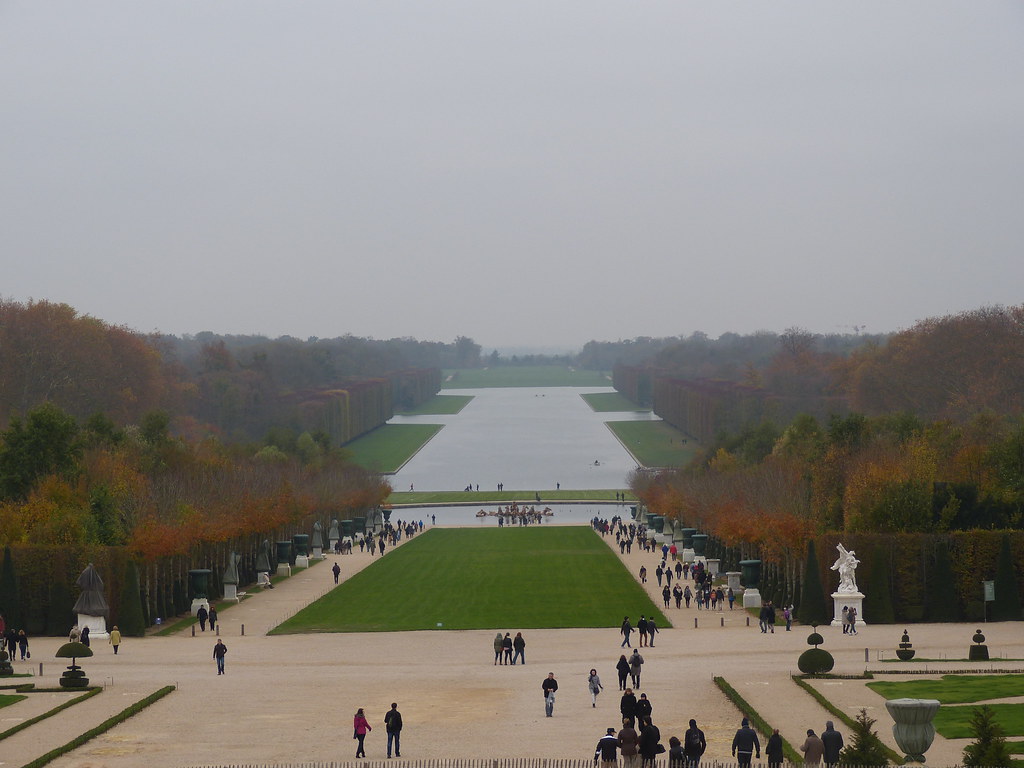
The gardens are full of geometric paths, carefully tended flower beds and hedges, with statues and buildings scattered everywhere. Pools of water and fountains decorate this beautiful place. It is a pleasure to walk around and discover the hidden gems of the gardens.
 
Gardens, Versailles
Another picture of the gardens


My friends and I decided to walk towards the Grand Trianon. After all, we didn't pay the full price only to see the main palace! The Grand Trianon is a smaller palace within the grounds of the estate, built so that the king could escape from the etiquette of the court and have light meals with his secret wife. After the Revolution, Napoleon lived here with his second wife Marie Louise. It is lavishly furnished, and it gives you the idea of the life at court: the king and the queen were not always relegated in the main palace, but had other places where they could enjoy life without many restrictions.
Grand Trianon, Versailles
A room of the Grand Trianon

 
Another such place is the Petit Trianon, a favourite retreat for Marie Antoinette. It is yet another château, built for one of Louis XV's mistresses, the infamous Madame de Pompadour, who unfortunately died four years after its completion. At the time, the king's chief mistress  had a semi-official status and had her own apartments within the court! Unfortunately, I didn't visit this part of Versailles because on that day it was very cold, and after walking from the main palace to the Grand Trianon my friends and I were tired and freezing. This means that I need to go back to Versailles!
 
Grand Trianon, Versailles
Another room of the Grand Trianon


How to reach Versailles

Can you believe that Lonely Planet's Paris city guide doesn't give you any suggestions on how to reach Versailles from the centre of Paris? Versailles is about 12 miles from the centre of Paris. To reach it you can take RER C, which is a train that serves Paris and its suburbs. Get off at Versailles - Rive Gauche, which is the closest train station to the chateau, only five minutes away. You cannot use your usual T+ ticket, but you need to buy a special ticket, because Versailles is in zone 4. Depending on where your accommodation is located, you can also take the "transilien L" train. It leaves you at Versailles Rive Droite, 15 minutes away from the chateau. I think a return ticket cost me 6,50€ .


Friday, 14 February 2014

I can't believe this is England: exploring Cornwall

For nine months in 2010, and then again for six months in 2012, I lived and worked in London. When you live in such a big and chaotic city, you can easily get bored of the asphalt jungle, of the crowds of people crossing the street, not to mention of endless grey skies. Since I had already explored England, Scotland and Ireland to a certain degree, I wanted to go to a part of the country that felt completely different. I almost booked a getaway to the Lake District, and I was seriously thinking of going to Wales for a change, but in the end the pictures on the web convinced me to tackle the long train journey to Cornwall.

Cornwall, on the westernmost corner of England, has a temperate microclimate, and therefore different plants can grow here, like cactuses and strange colourful flowers. My train left from Paddington station early in the morning, and as the English countryside passed in front of me, I could see many different landscapes: strange rock formations, huge bridges, and even a harbour half buried under the sand.


Cornwall sea
The sea in St.Ives

Friday, 7 February 2014

Three things that will strike you about Slovenia

I've only been to the north-western tip of this small country, riding the train from Nova Gorica to Bled and enjoying this lake town and its surroundings, including  the less famous but equally stunning Lake Bohinj and little jewels like the Vintgar Gorge. I can't therefore be considered an expert in everything Slovenian, but I'd like to write about three things that struck me in this beautiful country.

Lake Bled
Lake Bled
 
1) The mix of influences

Slovenia is an original mixture of the culture of the Balkans with that of Central Europe, with a zest of Italy, which is just around the corner. I felt incredibly at home in Slovenia, in spite of the different language and the difficult relationship that my country, Italy, had with Slovenia in the past because of language minorities and wars.

Just to give you an example of the influences that this country has to deal with, the waiter at the restaurant where I stopped on my way to Savica Waterfall knew how to say "skewer" in Italian, which is not exactly a word you use everyday. On the other hand, in the bar near my hostel, they had excellent cappuccino but no croissant, which every coffee place in Italy has in the morning. When I asked the waitress what people have for breakfast in Slovenia she humorously answered "kebab! And smoking cigarettes...", probably because she was selling kebab. I still don't know what Slovenians eat for breakfast, but I know that a cappuccino in Lake Bled is not unlike an Italian one!

For a visual example, just look at the  wrought-iron dragon in this picture taken inside the castle in Bled. The design makes me think of Eastern Europe for some reason.


Museum in  Bled (Slovenia)
Museum inside Bled Castle
I can easily imagine this castle with conical roofs dotting the landscape of Hungary.
 
Conical roof Bled
Conical roof at Bled Castle
And some of the chalets I encountered while hiking could have been Austrian houses.

Chalet, Slovenia
Chalet in Slovenia


2) The architecture

What makes the architecture of Slovenia so pleasant to see is the harmony with the surrounding landscape, rather than the artistic achievement of the single buildings. It looks like somebody put the buildings and built the houses taking in consideration the fact that one day tourists will come and snap pictures.

Bled (Slovenia)
The castle in Bled perched on a rock


Church, Bled
Gracious church on the island in Lake Bled

They say that Communism produced some monsters in terms of architecture, big ugly buildings that will look out of place everywhere, but I didn't see many of these.

3) The respect for natural beauty

The most obvious things about Slovenia, is its almost rustic charm and its natural beauty, still uncontaminated. Even where human settlement has arrived, it looked as if respect for the place was always taken into consideration. To me it seemed that Slovenians were always walking on tiptoe, as not to intrude on their nature. Wherever you look there are mountain trails, and possibility to do outdoor sports. Hiking is particularly pleasant in this country, and I've seen plenty of people.

 
Lake Bohinj
Canoeing at Lake Bohinj
The azure of the water of lakes and rivers will make you think that somebody has added soap in them, but it's clearly not the case. As a matter of fact, Slovenians are renowned in Europe for being particularly eco-friendly.
 
Relaxing in Lake Bohinj

 
Did I convince you to visit Slovenia?

Saturday, 1 February 2014

The Ghetto of Venice

"So now we will pass through the ghetto", I said casually while leading my new American friends through the calli of Venice.
 
"Oh my God" said one of the two young couchsurfers with surprise and apprehension, " is it dangerous?".
 
Little did they know that this was a completely different kind of ghetto, not a place of segregation, poverty and crime within an American city, but an area of the town where historically the Jewish population used to live, with restrictions certainly, but also in relative wealth. The word ghetto - which was later used for Nazi Jewish quarters in Eastern Europe or for racially segregated neighbourhoods in the United States - was in fact born in Venice to indicate the area where Jewish people were confined in the past. Its origins indicate a possible foundry that existed on the island that was chosen to accommodate the growing Jewish population of Venice in the 16th century.

Ghetto, Venice
Campo del Gheto Nuovo


Today the Jewish ghetto of Venice is, at least according to me, one of the most charming places in all of Venice. It is formed by a campo, the only one in the town without a church, and by several narrow streets. If you are not looking for it, you might as well miss it. Campo del Gheto Nuovo is a peaceful place, with children playing, the occasional Orthodox Jew walking by, and buildings taller than the ones you can see in the rest of the town. This is because the Jewish population of Venice was restricted to this area, so people built taller houses to accommodate everyone.
 
Tall Houses - Ghetto (Venice)
Tall Houses in the Ghetto

Ghetto, Venice
Children playing at the ghetto


It is almost impossible to distinguish the synagogues from the outside, as they were expressively built not to be ostentatious from the outside. You can identify one of them by a series of five windows with green shutters representing the first five books in the Bible. You can see another if you look at one corner of the square: that strange wooden structure with a small dome is the place in the synagogue where the ancient scriptures are read in one of the old historical synagogues. I think one of the reasons why Venice, and this area in particular, is so charming has to do with the state of decay of some of the houses and palaces, as if a veil of nostalgia made Venice more special.


Angolo ghetto, Venezia
A corner with the synagogue visible
The Orthodox Jews you will see in the square are not native of Venice, but they relocated from other parts of the world. Understandably, Venetian Jews nowadays live all over the town, and not only here. In a corner of the square there is a monument that remembers the Holocaust, with the names of all the people who were deported. It is indeed a touching monument, but don't make the mistake of associating the neighbourhood with this only.


Ghetto (Venice)
The monument commemorating the people who were deported
As a matter of fact, the area is peppered with art galleries displaying the work of Jewish artists, a couple of shops selling Jewish items, especially candleholders, and a kosher restaurant. The latter is not bad, if you fancy a change from the average Italian menu. What they offer is a mixture of Italian and Middle Eastern dishes, and they have a very nice and filling appetizer dish for €9,80. I find the area more lively than most Jewish streets or neighbourhoods in other Italian towns, like Ferrara. There are also a couple of bakeries, and a museum in a corner of the main campo.

Ghetto (Venice)
Kosher bakery

To visit the aforementioned museum, you can pay the normal entrance fee (4€) or ask for a joined ticket that will also give you the possibility to visit three synagogues with a guided tour that starts every hour, in English and Italian (10€). Don't visit the museum without the guided tour of the synagogues, because that's the highlight of a visit to the ghetto. The tour is very informative, and the guide will answer every possible curiosity you may have about the Jewish community in Venice. And of course, you'll have the opportunity to see the old synagogues and learn about the different congregations and the life of Venetian Jews throughout the centuries.
 

Ghetto (Venice)
A corner of the main square
I suggest that you don't miss passing through the ghetto while you're in Venice. The area is not far from the railway station. Just take the street that starts on the left of the train station (don't cross Ponte degli Scalzi), and go straight until you reach a bridge (Ponte delle Guglie). After passing the bridge, turn immediately to your left following the canal. Here you should see a yellow sign helping you. It's written in both Italian and Hebrew. Turn right under the stone doorway when you see a restaurant with tables along the canal.

The ghetto is not an overtly touristic area of Venice, and there are quiet canals all around it, so it's perfect for a pleasant walk on a sunny (or not so sunny day).
 
Ghetto (Venice)
The quiet Fondamenta degli Ormesini, near the ghetto

Monday, 27 January 2014

Exploring the Euganean Hills

Sometimes in Venice I crave real nature and want to see some idyllic country life, so a few days ago I decided to spend half a day in the Euganean Hills, lying a few kilometres south of Padua. The area is also a regional park, and it's dotted with agriturismi (restaurants that offer food that's locally produced) and bed & breakfasts. The Euganean Hills are also renowned for products like wine, honey, olive oil, and brodo di giuggiole (a liquor made with jujube fruits). To explore this region I took a train from Venice to Monselice (47 minutes) for €4,75 one way.

Euganean Hills
Euganean Hills near Arquà Petrarca


In Monselice there are some medieval fortifications, a tower and a castle perched on a hill. Unfortunately, when I visited it was winter, and the castle was closed, so I can't tell you if it's worth going in. In Monselice you have a magnificent view over the surrounding plain and the hills. There are also examples of architecture from other periods: villa Nani-Mocenigo was for example built at the end of the 15th century, and Villa Duodo at the end of the 16th century. They were both owned by aristocratic Venetian families, and still today they are very scenic, even seen from the outside. There is even a monumental staircase with statues to give you an idea of the extravagance of these families. For the Duodo family, Vincenzo Scamozzi also built the Seven Churches Sanctuary, which later became a pilgrimage site.
Monselice (PD)
Castle of Monselice

Monselice (PD)
Statues at Villa Duodo


Monselice
Staircase of Villa Nani
After having a look at Monselice, I took a long walk among the hills to reach another jewel of the area, the tiny village of Arquà Petrarca. It takes about one hour to reach it on foot, but the landscape is breathtaking. On the way I met many people on their bikes, hiking, or even horse-riding. Apparently it is not uncommon to do this passeggiata (walk) when the weather is nice. The road meanders through vineyards, farmsteads, and olive trees. Needless to say, it is beyond pleasant.

Colli Euganei
Euganean Hills between Monselice and Arquà Petrarca

Arquà Petrarca is an enchanting village, actually included in "I borghi più belli d'Italia", a list of the most beautiful Italian hamlets (I can't find a better word to translate borgo) . The place is famous because it hosts the house where the 14th-century poet Francesco Petrarca resided in the last years of his life, surrounded by olive trees and vineyards. Many famous people have visited the house, and the area, in the past centuries, including Lord Byron and Percy Bysshe Shelley. If you are visiting Colli Euganei, it is really worth paying a visit. The house itself is lovely, and it has some frescoes inside, as well as a small exhibition about the poet's life.


Casa del petrarca, Arquà Petrarca
The house of Petrarch

Arquà Petrarca (PD)
View from the balcony just before sunset
The village is pleasant even if you don't know much about Italian literature. Who said that you need to go to Tuscany to find peaceful and picturesque medieval villages where life seems  to have stopped?

Arquà Petrarca (PD)
Historical Arquà Petrarca


Arqua Petrarca
Arquà Petrarca

On the way back towards Monselice I saw a spectacular sunset: it encompassed all the colours from orange to pink and even violet. It was a short trip, but really rewarding. It was almost like travelling back in time, when the rhythms of life were slower...


Sunset among the vineyards, Euganean Hills
Sunset among the vineyards

Sunset Euganean Hills
Sunset again

Wednesday, 22 January 2014

The Other Czech Republic

Believe it or not, when I was in the Czech Republic a few years ago, I didn't go to Prague because I was visiting a couple of friends who live in the eastern part of the country, in a region called Moravia. There was so much to do there that I didn't feel like I missed out, saving Prague for my next trip to the Czech Republic.
 
I started my short trip from the city of Brno, the capital of Moravia. Brno is a typical central European city: churches have bell towers with onion-shaped roofs and cathedrals with many spires. The castle that dominates the city is worth visiting,  but it's not mind-blowing, in my humble opinion. There weren't many tourists in Brno, and I often found myself using the few Czech words I had learned in those few days in restaurants or at the entrance of small museums. I entered the Capuchin Monastery, for example, trying to make use of the language section in my guidebook. Incidentally, that was one of the creepiest places I have been to in my whole life: the bodies of some mummified monks are on display here, and  they are laid down in a natural position, unlike Egyptian mummies.

Brno
Brno (picture by Szymon Pifczyk, retrieved on flickr)

Brno
Brno, Cathedral of Saints Peter and Paul

Bishop's courtyard, Brno
Bishop's Courtyard, Brno

The old town hall has also left an impression on me, with its crocodile hanging from the wall at the entrance. As the legends say, the inhabitants of Brno have always thought it to be a dragon living somewhere in the surroundings, rather than a crocodile brought by an exotic visitor, perhaps a crusader or a Turkish sultan. I also remember eating smažený sýr (fried cheese) in a busy restaurant in the town centre, the most memorable meal I had in Czech Republic (or in Czechia, a term locals seem to prefer).

syr
Smažený sýr in Brno


My friend also introduced me to other parts of her region. The place I liked the most and that I remember with a bit of nostalgia is Telč, which is a UNESCO-listed small town surroundedby a delightful lake. The main square is really cute, circled as it is by colourful Renaissance buildings and a portico with shops selling knick-knacks and souvenirs. There is also an English-style chateau that you can visit. More than read about the historical importance of this place, situated on a busy commercial route between Austria and Bohemia, however, the pleasure of being in Telč is all about the atmosphere. My friend Taňa's parents have a bed & breakfast in town, and I remember eating my salty breakfast in the morning. One of the things travellers have a hard time adjusting to, someone remarked on that occasion, are different breakfast habits. In Italy, for example, we always have a sweet breakfast, never salty.
 
Telc Town Square
Beautiful Telc (photo by janlichterman, retrieved on flickr)
 
I also visited the castle of Lednice, very close to the border with both Austria and Slovakia. Although I have visited quite a few castles in my life, I still remember a room decorated with blue wallpaper and a beautiful wooden spiral staircase. The cultural landscape of Lednice and Valtice is a landscape park built in the 18th and 19th century by the House of Liechtenstein, and it's often called the Garden of Europe. As a matter of fact, the family that gave its name to the small country had possessions in all of central Europe. Lednice and Valtics are located in a vast area with two castles, and many pavilions, ponds and things like that. Photographs were not allowed inside the castle, but I managed to retrieve one from flickr.
 
Lednice. Schlossbibliotek mit Holzwendeltreppe
The wooden spiral staircase (photo by Alexander Szep, retrieved on flickr)


 Moravia is a region of caverns and gorges, so my friends and I had a trip to the Moravský Kras, the Moravian Karst. There are also some excursions down an impressive gorge to be done, but it needed a booking we didn't have. Unfortunately, the guided tour of the caves was in Czech, and my friends had to translate everything back into English. Most of the tourists in this area of the country were Czech, or from neighbouring Slavic countries. I wonder if this has now changed, or if tourists here are mostly local people.
 
Another highlight of the trip was the visit to Třebíč, a village famous for its gothic basilica with its rose window, but also for its well-preserved Jewish quarter. The latter was a rather moving thing to visit: it was completely deserted, and so different from the lively Jewish area I am used to in Venice. The Jewish cemetery, in particular, was rather spooky, but fascinating. I am not used to seeing the tombstones written in Hebrew! I really felt the burden of a culture that has been lost, that of the Jewish people living in these areas of central Europe. Sadly, all the Jewish residents of this place have been deported during the Second World War, and there is none left. Another thing I noticed in this UNESCO-listed place is how much interaction there must have been between the Christian and the Jewish population of towns like Třebíč in the past, seen that the church and the synagogue were so close.

Trebíc 2009-05-21 12.42.55
Jewish cemetery (photo by Ana Paula Hirama, retrieved on flickr)


Trebic, St. Procopius Basilica
St. Procopius Basilica in Třebíč (photo by MareK Prokop on flickr)

In conclusion, I think this post proves that it's important to go off the beaten path, and explore lesser visited regions, especially in a country like the Czech Republic which always gets praised because of its capital, Prague, but sometimes receives little credit for the rest.

Friday, 17 January 2014

Paris in the winter?

I went to Paris last November. I knew it wasn't the best season to experience the city, and it would probably be cold and rainy, but the cheap plane ticket was very tempting, and after all there is so much to do in Paris even when the weather is not helping!
 
Paris in the winter
Place de la Concorde in the winter


As you may know already, travelling in low season is a mixed bag. For example, it was an excellent idea in terms of the queues and the number of tourists on the street. As a matter of fact, I have been told that trying to enter Basilique du Sacré Coeur can be rather frustrating. In November, however, I entered the church without queuing and there were very few people inside it. It was the same for Notre Dame and Sainte Chappelle. I managed to enter 3 times  in Notre Dame  de Paris (it's free of charge) and climbed to the towers only the third time. The towers have different opening times from the rest of church, and the entrance is located somewhere else. I took me a while to find it out!


View from Notre Dame
View from one of the gargoyles in the towers of Notre Dame


It was an even better idea for the colours: in November there were still some autumn colours to enjoy, especially at Jardins des Tuileries. I didn't find the downcast sky particularly off-putting, but on the contrary it offered opportunities for countless strange pictures.
 
Paris in the winter
Autumn leaves and the banks of the Seine


Jarin des Tuleries in the winter, Paris
Jardin des Tuileries after the rain
While the Christmas lights were not up on the Champs Elysées, Galeries LaFayette were all ready for the Christmas season! There were lots of kids marvelling at the animations in the shop windows, and hundreds of tourists wandering the shopping mall just to get a glimpse of the huge Christmas tree. I am not a fun of luxury goods, so I didn't buy anything in Galeries LaFayette, but I had a good time taking pictures of the main hall.

Christmas tree at Galeries LaFayette
Christmas decorations at Galeries La Fayette

Looking at the shop windows at Galeries LaFayette
Shop windows at Galeries LaFayette

Going to Paris in November was a bad idea for one of the trips I was looking forward to, that to Versailles. Versailles in November was almost deserted (except from the hall of mirrors, where everybody seemed to congregate!), but I agree that it's a good thing. Nobody wants to share the view of carefully planned gardens with a million loud tourists who don't know a thing about French history, right? Going to Versailles win winter as nonetheless a disappointing experience: many fountains were closed, the statues in the garden mostly covered, and my friends and I inadvertently chose the coldest day to be there. Walking through the gardens was tiring, even though the colours were beautiful, and after visiting the Grand Trianon, we were too cold, so we gave up and decided not to visit Hameau de la Reine, which I wanted to see very badly.
 
Fountain Versailles
Main Fountain at Versailles

Grand Trianon, Versailles
Montmartre was almost devoid of tourists, and there were no artists at the bottom of the Basilique du Sacré Coeur. I loved Montmartre, and it was in fact one of my favourite neighbourhoods of Paris, but I am sure that it will be even more picturesque when it's bustling with life, but maybe not too much, as too many people will spoil the atmosphere. I loved that the area still feels like a village in the countryside, rather than a  neighbourhood in one of the most cosmopolitan cities in the world.

Mont-Martre
Basilique du Sacré Coeur

Pittore, Montmartre
Sketch artist in Montmartre

Walking in the footsteps of Toulouse-Lautrec and Renoir, two of my favourite French painters, was thrilling. I went in search of the two surviving winding mills in the area, and when I arrived in front of the Moulin de la Galette, site of the famous guinguette (a typical drinking establishment of the past) portrayed by Renoir in the famous painting, I could not help but snap a picture and wonder how Montmartre might have been back then.


Moulin de la Galette, Montmartre
Moulin de la Galette, Monmartre


While museums were full of people, the streets were free to wander and Parisians were definitely the majority almost everywhere. In conclusion, there are certainly good reasons to go to Paris in November, but I'm willing to try this city in every season!
 
Torre Eiffel
Tour Eiffel and the clouds
 
01 09 10