Showing posts with label Lisbon. Show all posts

Sunday, 12 November 2017

Around the world in 15 meals

1) Instanbul, Turkey

What is there better than a plate of meze on a hot day in Istanbul? This is supposed to be just an appetizer, but it worked fine for me as a light lunch. It included various dips like hummus, eggplant salad and haydari, then dolma (stuffed vine leaves) and some cheese. Everything with vegetable sticks for the dips. By the way, that puffy bread is called lavas and I love it. 


Meze lunch in Istanbul

2) Mostar, Bosnia

One of my favourite meals in Bosnia and of the whole Balkan trip was the Hadzijski cevap (marinated beef with peppers and rice) that I had in the old town of Mostar. It was simple but delicious, and also really cheap! 

Bosnia


3) Amsterdam, Netherlands

What to do when you are visiting a country that is not really famous for its cuisine, you've already tried the obvious and looking around you can only see burgers and fries? In big cities in central or northern Europe, like Munich or London, I usually find that Asian food is top notch. So while in Amsterdam, I repeatedly stopped by Indonesian and Thai restaurants. My favourite was Bird Thai restaurant in Chinatown (close to the red light district). 


Red Thai curry in Amsterdam


4) Lisbon, Portugal

If I could recommnend only one Portuguese dish it would be  bacalhau com natas. The Portuguese have many ways to cook cod, but creamy bacalhau com natas is my favourite. I was lucky enough to participate in a dinner organized by my hostel in Lisbon and this is how I got to taste this delicious typical dish. I am already making plans to go back to Portugal and have it one more time. This is how much I liked it!


Bacalhau com natas
5) Schwangau, Germany

It might not be haute cuisine but I just had to try currywurst in Germany, if only for curiosity. The history of this spiced sausage is quite interesting, because it was invented in Berlin just after WWII borrowing curry powder and ketchup (or possibly Worcestershire sauce) from British soldiers. It became a popular snack with the workers who were rebuilding the devastated city, and it is still today a popular take-away food, not only in Berlin but all over Germany.


Currywurst in Germany
6) Marrakesh, Morocco

Vegetarian tagine in an informal restaurant in the medina of Marrakesh - my favourite kind of place where you don't feel weird if you're eating alone (in this case I wasn't). Tagine is the name of the earthenware pot where food is cooked, so you could have many different of tagine: chicken with vegetables, but also with sardines by the sea or with meat and dried fruit. I had this with a glass of orange juice, which seems to be ubiquitous in Marrakesh.

A vegetarian tajine in Marrakesh

7) Paris, France

This dish had a name so long that it did not fit in a single line on the menu. Then it turned out to be a steak with potatoes. Overall, my experiences with food in Paris went better when I blatantly tried not to order French food: for example at felafel joints or at a Korean restaurant. I think I owe Paris - and France - a second chance. Next time I'll document myself and try to order some French food with a better understanding of French cuisine.

A meal in Paris
8) Mdina, Malta

From a culinary point of view, Malta is a mix of influences. And how could it not be so? In spite of having been an English colony in the past, Malta is decidedly more Italian than British when you sit down for lunch or dinner. These spaghetti all'amatriciana - which means in a tomato sauce with pancetta (or even better guanciale) and chilli peppers - were really good. I discovered later that many Italian restaurants in Malta are owned by Italian people, hailing from all over the country and enjoying Malta's relaxed lifestyle and mild weather. 
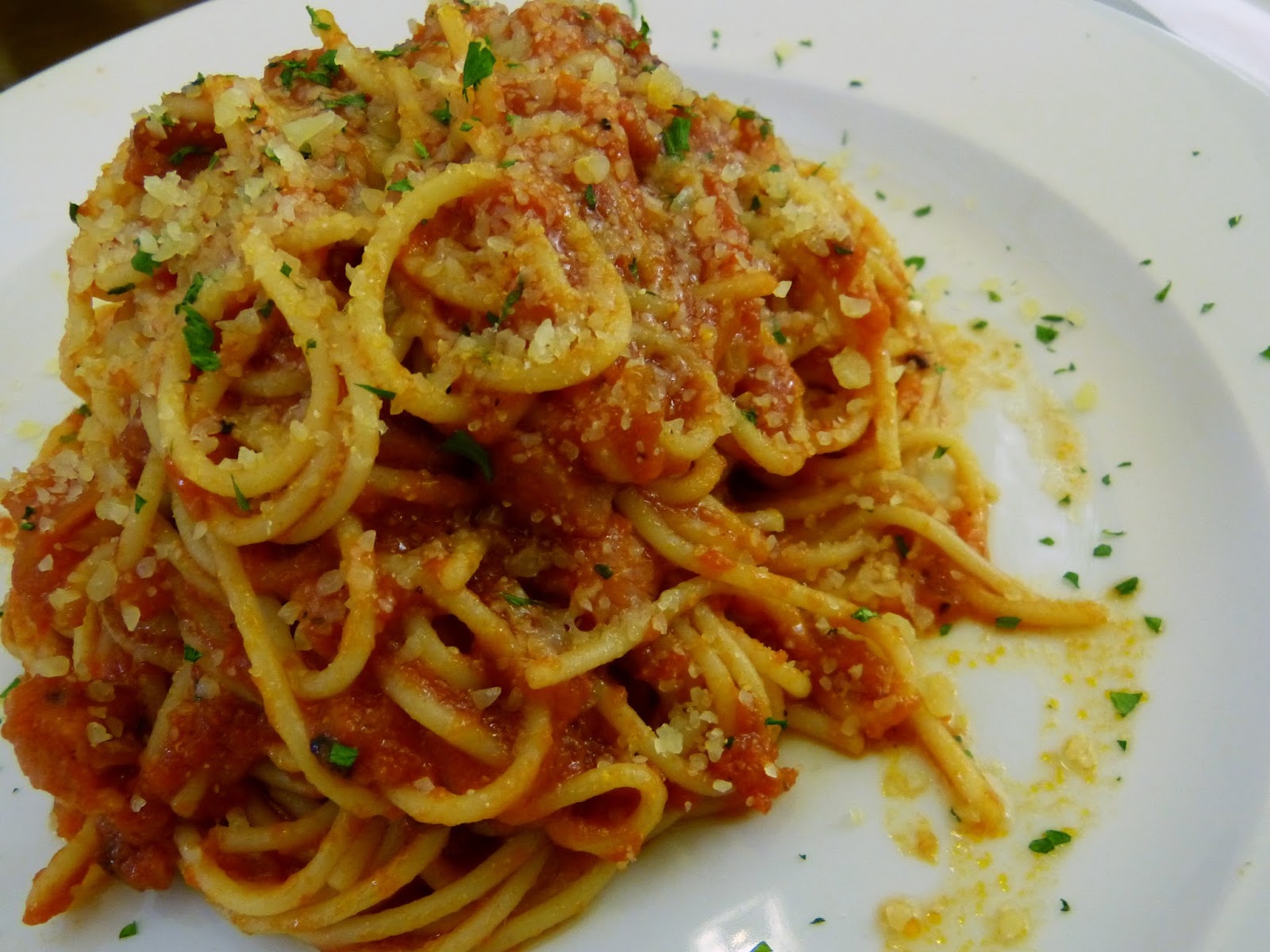
Pasta all'amatriciana in Malta

9) Stratford-upon-Avon, United Kingdom

I'll always remember this bento box meal I had in Shakespeare's hometown, Stratford-upon-Avon. The Japanese chef was entertaining us, pretending to throw bottles at the clients and things like that. The food didn't look that Japanese, apart from the yakitori, but it was the first time that I had lunch in a box, and I loved the idea.


10) Valencia, Spain

You cannot get bored with all the food in Spain: pintxos from the Basque Country, tapas that may include fish or cured meats like chorizo or jamon iberico, and regional specialities such as the Andalusian gazpacho. After more than three years in Spain I am still busy discovering all its variety. Nothing beats, however, a good seafood paella in a fishing town. 


A paella in Valencia


11) Split, Croatia

For the most part I found Croatian food uninspiring.  They once served me cod telling me it was a more prestigious seabass, while risotto and pasta were only an imitation of what you would have in Italy (which is so close after all). This tuna salad, nevertheless, on the city beach in Split, was really good, and just what I needed after a morning of sunbathing and dipping my toes in the turquoise waters of the Adriatic.

Tuna salad in Split


12) Kotor, Montenegro

All over the Balkans you will find these spiced sausages: ćevapčići. Sometimes - especially in Serbia and Bosnia - they serve them with a piece of flat bread, with chopped onions and sour cream, but in Montenegro I had it with French fries. I really enjoyed the meal, plus I had a perfect view of the main square of Kotor.

Cevapcici in Kotor


13) Brno, Czech Repulic

Czech Republic might not be famous as a culinary destination, but I had a few good meals there. It was long ago, but I still remember having Smažený sýr, different kinds of fried cheese served with potatoes and salad. This was in Brno and not in Prague (I must be the only person in the world who has been in the Czech Republic but hasn't been to Prague).

Smažený sýr in Brno


14) Bangkok, Thailand

I arrived in Bangkok after travelling for many hours (and after two sleepless nights) and I went directly to take a much deserved nap. A couple of hours after I woke with a grumbling stomach and went for a Pad Thai in the neighboorhood. It was not long after that I became addicted. It is a simple dish after all: noodles with  bean sprouts, some prawns or seafood, and cashew nuts sprinkled on top. Oh, and don't forget a sprinkle of lime and some chilli peppers to have that caracteristic taste. 


15) Pisa, Italy

And last but not least Italy, my country. Even though I am Italian, each time I visit a new region I discover new things to taste. Italy is not only pasta and pizza, as I keep saying to those who think that Italian cuisine is boring! We have plenty of that, for sure, but also other dishes: risotto in the north, delicious grilled fish and seafood served with plenty of vegetables, soups with pulses in Tuscany and meat with mushrooms or polenta in the mountains. My favourite, though, is always pizza!

A pizza in Italy


Sunday, 18 January 2015

Lisbon: Sun, sky and poetry

Lisbon is a city famous for its blue skies, and indeed I found only blue skies when I was there in the middle of the winter. Still warm and welcoming in this season, I found Lisbon to be a manageable city: not too big, and not too chaotic, but charming in that Southern European way that I love so much.
 
It's a city of stone staircases (there are probably more here than I've seen in any other city!), with elevators - cable cars, some of them vertical - that can take you "up a level". For this reason, Lisbon can be a bit disorienting. It's full of viewpoints (miradouros in Portuguese), and built on top of seven hills, like Rome, with the river Tagus that could almost be mistaken for the sea.
 
View from the Castle of San Jorge
 
The castle of San Jorge is worth visiting mostly for the views, so I think the entrance fee should be abolished, and the castle grounds converted into a public park. Lisbon is a peculiar city in terms of sightseeing: neither the castle nor the Cathedral are anything special. The charm of Lisbon lies rather in walking around in search of  picturesque corners, admiring the views of the red roofs and the whitewashed houses, enjoying its paved squares, and of course taking many pictures of the photogenic yellow trams.
 

View of Lisbon from San Jorge Castle

You  hear the characteristic horn of the tram very often, while walking around Lisbon. When it will appear from behind a corner, it will always brings a smile to your face and it will become a familiar view. Of course the trams are not only yellow, but all colours, and some are of  the newer kind. Number 28 is the most famous among the old ones, because of its route: it allows you to see much of the old town from your window seat. I took it one morning, observing the mix of people - tourists, but also old Portuguese men and women  who just bought their groceries - and staring out of the window, enjoying the good weather and the views.  


The famous yellow tram

 
One of the most characteristic neighbourhoods  of Lisbon is the Alfama, in the old town. This is where the fado was born. It's a popular neighbourhood somehow reminiscent of Naples, with narrow streets, stone staircases and laundry out to dry. Every step hides a surprise in this part of Lisbon: here and there you will find a nice square, and even some ruins from the Islamic period with a spooky tree and  random - but amazing - street art.


A spooky tree grows in Alfama

The Alfama, whose names clearly comes from the Arabic, constituted the whole of the city during the period of the Moorish domination. Getting lost in this area of the city is a real pleasure, but not for your legs, who will have to tackle a lot of stone steps! A pastel de nata in a typical pastry shop might help you here: there are endless places in Lisbon where you can have something sweet, because apparently Lisboetas have a sweet tooth.

One of the many staircases of the Alfama

Streets of Alfama
A corner of Alfama


Street art in the streets of Lisbon

There are some names and events that I heard mentioned many times while I was in Lisbon, either in my guidebook or by locals: Henry the Navigator, the age of discoveries, and of course the terrible earthquake of 1755. The most fascinating monument connected with that tragic event that almost destroyed Lisbon is the Igreja do Carmo, a church which is now in ruins, with no roof. It has been converted into an archaeological museum, and I can assure you that it's very atmospheric to walk between its walls, because it's not everyday that you see ruins of a 18th century church. It's almost as if you time-travelled to a catastrophic future, when ruins don't only date back to the Greek or Roman times, but also to the more recent past.  


Igreja do Carmo

The archeological museum in the Igreja do Carmo


Lisbon is also the hometown of some of my favourite writers. I take great pride in this picture taken with the statue of Fernando Pessoa, one of my favourite poets. The statue is located  in the central neighbourhood of Chiado, in front of "A Brasileira", a café that he used to visit rather often. I really enjoy taking "literary side-trips", since I like reading. Poets are some of my favourites authors to track down, maybe because places are often important in their work. I've visited Keats' house in Rome, as well as  Oscar Wilde's grave in Paris, but I also giggled when I ran into a sign inside a bar in Madrid that read "Hemingway has not been here".  


With Fernando Pessoa


The famous Elevador da Santa Justa was being restored when I was there, so you couldn't see anything from the outside. You can either pay for a ride and for the terrace, or enter from behind the Igreja do Carmo and only pay for the terrace. I would advise you to skip the actual ride, as you don't see anything special, enter from behind the church and go straight to the rooftop terrace. Be warned: this is only one of the many viewpoints in Lisbon, and you have to pay to enjoy it. The Miradouro das Portas do Sol is equally beautiful, in my opinion, and completely free of charge. 


View from the top of the Elevador da Santa Justa


Oh, and if you're one of those people who chases sunsets wherever they're travelling, Lisbon is the place for you. From all along the river Tagus you can enjoy amazing sunsets over the red suspended bridge, with a view of the statue of the Christ redeemer on the other site of the river. As a matter of fact, if the suspended bridge is reminiscent of San Francisco, the statue of the Christ is similar to the one in Rio de Janeiro, except there is no Pão de Açúcar and no bay, but a wide river delta and some cool open-air bars where you can sip a drink while watching the sunset.


Sunset in Lisbon


What do you think about Lisbon? Is it a city that you would want to visit?

Sunday, 28 December 2014

A day in Belém - the best Lisbon has to offer

I can't believe how many tourists miss Belém, located 15-25 minutes away from the centre of Lisbon by tram. It is an area filled with important monuments - from renowned museums to religious buildings and gardens - and it's very nice if you just want to take a walk.  Here you can see one of the best things that Lisbon has to offer: a dive back to the time when Portugal led the way to the discoveries of other parts of the world. It was perhaps my favourite part of Lisbon, more than the Alfama or the Chiado, and this is why I want to write about it first. The weather helped me: even though it was December, the sky was blue and clear, those famous clear blue skies of Lisbon that poets write about.

I caught the tram - n.15 to be precise - from Cais do Sodre train station, near my hostel. The tram was crowded and the journey a bit uncomfortable, but I met an old Portuguese man who spoke perfect Italian, and taught me many things about Portugal and Lisbon. We passed the famous suspended bridge, Ponte 25 de Abril, which takes its name from the date of the Carnation Revolution and that looks so much like the Golden Gate Bridge. Just the day before I had enjoyed an amazing sunset involving the bridge, from the banks of the river Tagus.

Lisbon Sunset
 
As soon as I got to Belém, I found myself in front of the first of the many attractions of the area.  I know that I would love it, and I did: the Mosteiro dos Jerónimos was on my top three things to visit in Lisbon. Not only it has a distinctive architectural style not to be found in any other European country - the Manueline style - but it is also beautiful and elegant. The most striking element is the southern portal, so full of intricate decorations and almost blinding in its whiteness. Founded with the money coming from the trades with the colonies, the monastery was built in the 16th century to offer spiritual assistance to the navigators who left from the harbour nearby.

The western portal

Detail of the portal


The cloister of the monastery is all a game of shadows and decorations. I spent half an hour just admiring every nook and corner of it, especially the shadow and light on the walls.

The cloister of the monastery

From another angle


After visiting the monastery, I decided to enter the church adjoined. Here are buried famous Portuguese people, like the poet Camoes and the navigator Vasco da Gama. This church left an impression on me with its slender pillars, the ceiling high above, and its whiteness.

The church of Santa Maria de Belém
 
 
After visiting the monastery, I took a short walk to visit the Monument to the Discoveries, with all the statues of the explorers who left from this area. From here you have a magnificent view of the suspended bridge, but it's also a perfect area to walk around and enjoy the sun.

Monument to the Discoveries and Ponte 25 de Abril in the background
 
 
The Tower of Belém is maybe the most famous monument of all Lisbon and it's the jewel of Belém. Built as a defensive tower, it resembles a piece of the chessboard. The white of the limestone and the location, close to the riverside, makes it look almost unreal, as if you were in a fantasy movie or a fairy tale. It's a pleasure to visit it: there are so many intricate details and the view is amazing. José Saramago, in his book "Journey to Portugal", mentions Carlos Queirós, a Portuguese poet,  who in a moment of unbelievable humbleness wrote: "So isto fazemos bem, torres de Belém" ("There's only one thing we do well, build towers of Belem"). Saramago dismisses Queirós's humorous opinion, but he is one who dislikes and criticizes most Portuguese works of art in his travelogue about Portugal. Not the Tower of Belem, though, of which he writes: "the traveller cannot understand what military use this exquisite piece of jewellery could have had, with its wonderful lookout turrets facing the river Tagus, much more suited to watching naval regattas than for positioning cannon to help repel any invader" (p.330).  
 
In front of the Tower of Belém
 
Tower of Belem
View of the river fom the Tower
The tower in all its whiteness


After visiting the Tower of Belém I looked for a place to have lunch, as my stomach was beginning to groan. I decided to trust the Lonely Planet and I stopped at Floresta, where I had a plate of grilled sea bass with boiled vegetables, a simple but delicious meal al fresco (yes, it was warm enough!). It is a habit of Portuguese restaurants to bring you some bread, cheese and butter at the beginning of each meal. You will be charged for it, but don't worry, it won't break the bank! 
 
After lunch I decided to indulge myself and visit the Berardo Museum of Contemporary Art, situated just a short walk away. It's completely for free and it hosts masterpieces by Warhol - his Portrait of Judy Garland - and Dali, like a version of his famous lobster telephone.
 
Dali's lobster telephone


And of course a trip to Belém would not be complete without a stop to eat a pastel de nata, the simple but delicious Portuguese sweet that was born in this neighbourhood, in the kitchens of the monastery. I have eaten many pasteis de nata during my stay in Portugal, and I can assure you that the one from Fábrica de Pasteis de Belém was the best: crispy on the outside but creamy and tender inside. Even though this is an old and very famous pastry shop, with rooms decorated with azulejos, it was not at all expensive. One pastel de Belém costs around 1€. 


Pastel the nata with tea in Belém


Did you enjoy Belem? Would you make sure not to miss it when in Lisbon?
01 09 10